

News and blogs

Read our news and articles.

All articles

Blog Series: Battery Energy Storage Systems in Electricity Markets – Part 1

This article is the first part of a three-part blog series titled Battery Energy Storage Systems in Electricity Markets. The series explores how battery energy storage systems (BESS) operate in electricity markets, how they are integrated into reserve markets, and practical experiences from testing different ancillary services. In this first part, we focus on BESS from the perspective of electricity markets.


Battery energy storage systems from an electricity market perspective

Battery energy storage systems have become a key element in the ongoing transformation of electricity markets. Flexibility has become one of the most important characteristics of modern power systems. However, in practice, flexibility is not achieved through battery capacity alone. The critical factor is how the entire system is designed, controlled, and integrated into both the power system and electricity markets. This is where differences between BESS solutions become evident.

At Syncron Tech, we have been involved in several battery energy storage projects in recent years. Based on our experience, the technical implementation plays a decisive role in project success. A common assumption is that a battery system can be directly connected to Fingrid’s reserve markets. In practice, the situation is more complex. There are significant differences between battery technologies and system implementations, for example in response times, control accuracy, and controllability. These characteristics ultimately determine whether the system meets market requirements and passes the required compliance testing.

These challenges typically become visible during the grid compliance assessment process. This is not about a single requirement, but a combination of several aspects, including frequency and voltage support, measurement systems, protection schemes, and real-time communication. In many projects, it becomes clear at this stage that inverter-level control alone may not be sufficient.

PPC as the bridge to electricity markets

At this point, the control system becomes essential, particularly the Power Plant Controller (PPC). Centralized plant-level control enables the entire facility to be operated as a single coordinated system, implementing the control logic required by Fingrid and adapting to the requirements of different reserve markets. It also enables reactive power capability at the point of connection and supports required market communication interfaces. In practice, the PPC acts as a bridge between the technical system and electricity markets.

The overall solution matters

Recently, attention has also been drawn to the practical operation of battery systems. Reserve markets require fast power changes, which means continuous switching between charging and discharging and steep ramp rates. However, overly aggressive control strategies can accelerate battery degradation, reduce performance, and in the worst case impact warranty conditions. Therefore, a balance must be found between market optimization and technical lifetime performance.

In many projects, a workable approach has been to keep the core BESS delivery relatively lean, while complementing the overall system with a dedicated PPC solution. This provides the necessary flexibility without overengineering the entire installation. At the same time, it improves interoperability between different stakeholders, such as traders, control centers, and grid operators.

It is also important to note that grid code requirements are extensive, and it is not always practical to implement everything in-house. Competent partners therefore play a key role throughout different phases of the project. When system architecture, control strategy, and market requirements are considered as a whole, a battery energy storage system becomes more than just a physical asset — it becomes an active and value-generating part of the power system.
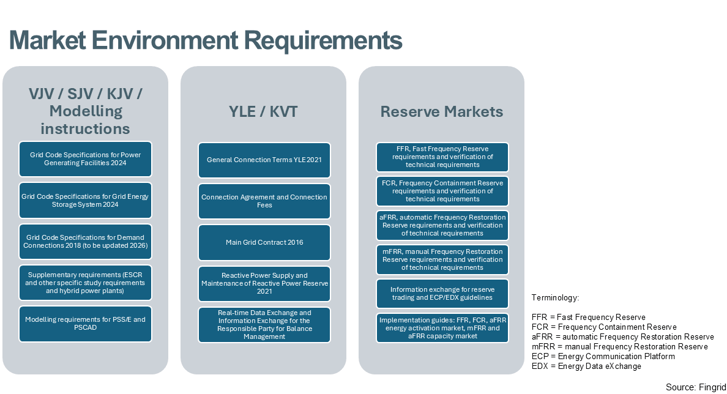
Market Environment Requirements-1

The blog series continues in the autumn with new topics. The following parts will focus on bringing battery energy storage systems into reserve markets and practical experiences from testing different reserve products.

Have a great summer.


You could be interested about these

Blog Series: Battery Energy Storage Systems in Electricity Markets – Part 1

This article is the first part of a three-part blog series titled Battery Energy Storage Systems in Electricity Markets. The series explores how battery energy storage systems (BESS) operate in electricity markets, how they are integrated into reserve markets, and practical experiences from testing different ancillary services. In this first part, we focus on BESS from the perspective of electricity markets. Battery energy storage systems from an electricity market perspective Battery energy storage systems have become a key element in the ongoing transformation of electricity markets. Flexibility has become one of the most important characteristics of modern power systems. However, in practice, flexibility is not achieved through battery capacity alone. The critical factor is how the entire system is designed, controlled, and integrated into both the power system and electricity markets. This is where differences between BESS solutions become evident. At Syncron Tech, we have been involved in several battery energy storage projects in recent years. Based on our experience, the technical implementation plays a decisive role in project success. A common assumption is that a battery system can be directly connected to Fingrid’s reserve markets. In practice, the situation is more complex. There are significant differences between battery technologies and system implementations, for example in response times, control accuracy, and controllability. These characteristics ultimately determine whether the system meets market requirements and passes the required compliance testing. These challenges typically become visible during the grid compliance assessment process. This is not about a single requirement, but a combination of several aspects, including frequency and voltage support, measurement systems, protection schemes, and real-time communication. In many projects, it becomes clear at this stage that inverter-level control alone may not be sufficient. PPC as the bridge to electricity markets At this point, the control system becomes essential, particularly the Power Plant Controller (PPC). Centralized plant-level control enables the entire facility to be operated as a single coordinated system, implementing the control logic required by Fingrid and adapting to the requirements of different reserve markets. It also enables reactive power capability at the point of connection and supports required market communication interfaces. In practice, the PPC acts as a bridge between the technical system and electricity markets. The overall solution matters Recently, attention has also been drawn to the practical operation of battery systems. Reserve markets require fast power changes, which means continuous switching between charging and discharging and steep ramp rates. However, overly aggressive control strategies can accelerate battery degradation, reduce performance, and in the worst case impact warranty conditions. Therefore, a balance must be found between market optimization and technical lifetime performance. In many projects, a workable approach has been to keep the core BESS delivery relatively lean, while complementing the overall system with a dedicated PPC solution. This provides the necessary flexibility without overengineering the entire installation. At the same time, it improves interoperability between different stakeholders, such as traders, control centers, and grid operators. It is also important to note that grid code requirements are extensive, and it is not always practical to implement everything in-house. Competent partners therefore play a key role throughout different phases of the project. When system architecture, control strategy, and market requirements are considered as a whole, a battery energy storage system becomes more than just a physical asset — it becomes an active and value-generating part of the power system.

Vaasa EnergyWeek 2026 March 16–19

Vaasa EnergyWeek brings together energy industry professionals from around the world to exchange the latest insights, network, and discuss future solutions for the industry. The event is scheduled for March 16–19, 2026, at Vaasa City Hall. Each day will focus on a specific theme: Energy & Climate, Wind & Renewable Energy, Energy Storage, and Clean Gas Energy. The program will also highlight key topics such as digitalization, the circular economy, business and innovation. The week begins with a seminar, Energia- ja ilmastoseminaari (in Finnish), while the rest of the program will be mainly in English. Exhibitors will open their booths on the second day of the event. Syncron Tech supports the energy industry's transformation by providing key solutions for project developers. Our solutions cover planning, operational phases, and asset condition management. Hybrid solutions for renewable energy production are becoming increasingly important as transmission grid capacity is limited and new connections are not always available. Efficient hybrid solutions can still be implemented within existing grid connections. Visit us at booth B12–13, where Lasse Kankainen and Jussi Eskelinen will be present from Tuesday to Thursday. We will be pleased to discuss how we can support your projects, whether they involve wind, solar, or energy storage. We are also glad to share our perspective on the potential of flexible electricity connections as part of a comprehensive solution, especially when production and consumption converge at a connection point, and the overall system requires an intelligent power management solution – such as in industrial facilities or data centers. See you at the event! Vaasa EnergyWeek provides an excellent opportunity to stay informed about the latest developments in the energy industry and to network with industry professionals. Read more about Vaasa EnergyWeek 2026 here.

Power Management Systems as Enablers of Flexible Electricity Connections

Did you know that starting January 1, 2026, an amendment to the Electricity Market Act will enable flexible electricity connections? The power system is undergoing rapid transformation. Industrial electrification, renewable energy generation, energy storage and new high-demand loads are driving a rapid increase in connection capacity requirements, while in many areas the grid is already operating near its limits. Flexible electricity connections provide a solution in situations where full connection capacity is not immediately available. They enable investments and operations to commence without long waiting periods for grid reinforcement. In practice, however, a flexible connection always requires a reliable power management system.